

What's with all the slide decks?
a polycausal theory
News from the world of real jobs: Apparently, sometime between 10 and 20 years ago, it became standard for people to communicate by sending slide decks around. These slides are never presented. They aren’t intended to be presented. They’re born, they’re sent around, and they die. What?
I stress, the question is not why (or if) people give bad presentations.
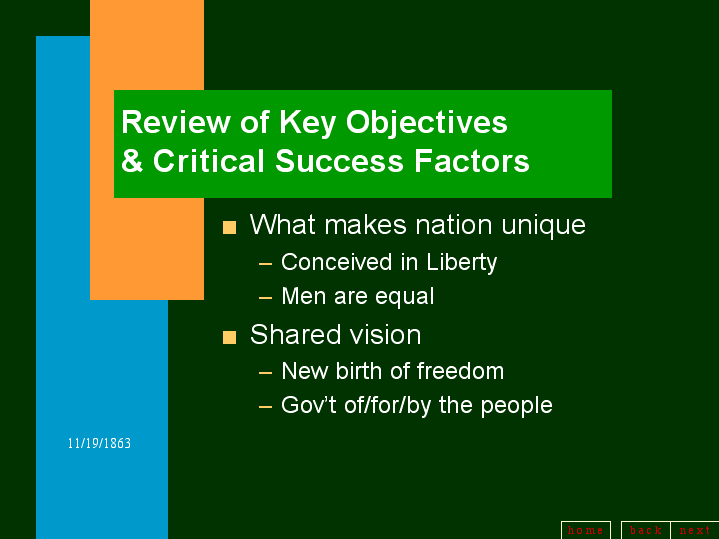
The mystery is why everyone is using presentation software for communication that is not a presentation.
Theory 1: Everybody dumb
Is it because we’re all dummies? I’m putting this theory first because I suspect that you, beloved readers, will favor it.
True, if you ask people why they make slides instead of writing, they’ll usually say, “because nobody wants to read”. So there’s that. But I don’t consider this much of an explanation. Dummies though we may be, we’ve been like that a long time. If we entered the Slideocene 15 years ago, why then? Why not before?
Theory 2: The decline of reading
Did we get worse at reading? The Discourse seems to have decided this is true, but is it true, or just moral panic?
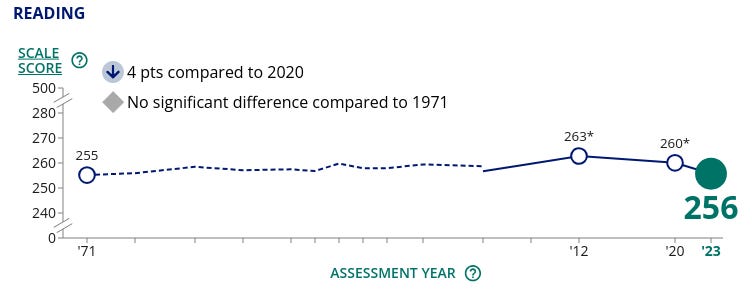
Since 1971, the US has tested 13-year-olds to measure long-term trends in reading ability. This shows a slow improvement until 2012, then a slow decline, and finally a post-COVID drop. The declines seem too small and too late to explain our mystery.
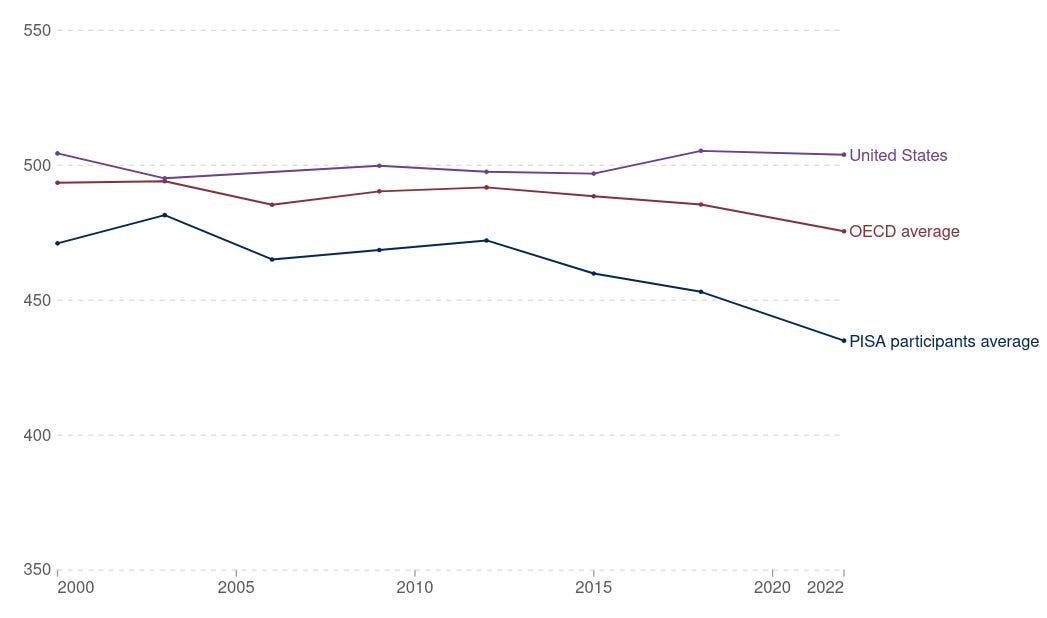
Since 2000, PISA has tested reading performance in 15-year-olds around the world. This shows a decline on average, but it’s smaller in rich countries and nonexistent in the United States. (It’s the same story for science and a bit more negative for math.)
Among adults, data is scarce. Basic literacy is generally improving, and American time use data shows a decline in reading for pleasure from around 23 minutes per day in 2003 to around 16 minutes per day in 2023. But this seems to miss time people spend reading on their phones.
So it’s unclear if people got worse at reading. It feels plausible that people now spend less of their adulthood grappling with complex written arguments, and so got worse at that. But there’s little firm evidence.
Theory 3: Technological change
Another obvious theory is that we now have computers and software and the internet. Without these things, it would be impossible to email slides to each other. This seems relevant!
Yes, but we had those things for a while before slide culture really took hold. And think about the situation before computers. Photocopiers were ubiquitous in corporate offices by the mid-1980s, and mimeographs were around decades before that. If slides were really that great, people could have made them by hand. But no one did.
Of course, making slides by hand is inferior. But it’s not that inferior. So slides can’t be that big of a win.
What actually happened?
And… that’s pretty much the end of the obvious theories. None of them are very satisfying. So let’s take a step back. Historically, how did the slide-as-document displace the memo?
As best I can tell, this was driven by management consultancies. If you go back to 1960, they delivered detailed written memos. The memo was the product. They’d likely give a presentation as well, but that was a separate ancillary thing, likely done using flipcharts or chalkboards.
In the 1970s, the memo was still the product, but consultancies started to enforce a top-down logical structure (the Pyramid principle). Presentations shifted to acetate transparencies. Both memos and presentations often included hand-drawn graphics like the nine-box or growth-share matrices.
In the 1980s, the memo was still the product, but presentations became increasingly lengthy and polished. Expensive computers like the Genigraphics started to be used to generate charts.
The 1990s were when things started to shift. By then, PowerPoint was everywhere, and junior analysts were expected to create presentations themselves. Consultancies gradually started to notice that (1) clients didn’t always read the memos; (2) clients loved slides and passed them around long after the presentation was over; and (3) creating a memo and a polished presentation was a lot of work. They put more and more effort into the slides. McKinsey especially evolved towards treating slides as the primary product, and mostly stopped writing long memos. Other consultancies followed.
During the 2000s, slides became even more ornate. Consultancies evolved their formatting rules, and created fancy data-dense charts. They learned that a 200 slide deck made clients feel like they got a lot for their money. Gradually, they oriented their entire business around slides. Projects would start with managers creating a template presentation with “ghost slides” and assigning different parts to junior analysts. Soon, this spread outwards, both from people who interacted with consultants and from the ex-consultant diaspora. People everywhere started thinking and communicating in slides, and now everything is slides, yay!
Alternative history
That story makes slides-as-documents sound inevitable: People liked them, so they became popular. But there’s an alternative timeline in which we resisted the slide into slide maximalism. That timeline is Amazon.com, Inc.
In 2004, Jeff Bezos famously instituted a no-presentations policy at Amazon. His logic was that slides hide poor reasoning and are a tool to persuade rather than inform. Instead, everyone involved with strategic decisions at Amazon needs to learn to write a six-page memo. Meetings begin with everyone sitting and silently reading one of these memos.
Presentation software is not banned at Amazon. The ban is only for using it for internal meetings and decision-making. They use slides for external communication. There is no policy that prohibits someone from making slides and emailing them around.
And yet, people don’t make slides and email them around, because it’s not part of Amazon’s culture. In effect, Amazon is a counter-movement. Most of the world decided that slides are good, because slides are easy. Bezos decided that writing is good because writing is hard.
There are millions of articles explaining why Bezos’ policy is pure genius. They claim that constructing a narrative requires deeper analytical thinking and exposes flaws in logic. I want to believe those theories. I now realize they’re very similar to some of my arguments for why writing with too much formatting is bad.
I’m not sure if writing is the secret to Amazon’s success. But Amazon is successful. This demonstrates that slide life is a choice, not technological destiny—institutions can choose writing over slides and flourish anyway.
OK so then what’s happening?
Warning: If you like your theories simple and mono-causal, you aren’t going to like this.
Slides are a win, but a small one. The shift to slides wasn’t a “mistake”, it happened because people like it. But if sharing slides outside of presentations became illegal, this wouldn’t cause per-capita GDP to crash. That’s why people didn’t scratch slides into mimeograph stencils back in the 1950s. It wasn’t worth the modest effort.
When computers and software showed up, it became easier to share slides. But people didn’t immediately shift to slides-as-documents because the win isn’t that big, because culture changes slowly, and because everyone had pre-existing skills for reading and writing documents.
Consultancies happened to be in the economic niche with the strongest selection pressure to evolve towards slides-as-documents. So when making slides became cheaper, they shifted. Slowly, that norm spread outwards, people got used to communicating in slides, and here we are.
Institutions can resist that norm and still be successful. If you take modern people and force them to read and write, they do just fine.
Humans evolved to learn and communicate in a fragmented, interactive, and visual style. It’s hard to argue that any shift in that direction is a catastrophe.
Except blogs. The decline of the blog must be arrested.
I hated slides, derided them as lowbrow. I rebelled in my industry and wrote white papers when others sent slides. Then I saw the light. Here’s what changed my mind:
1) Tufte’s books: Beautiful Evidence, Visual Explanations, Envisioning Information, and my favorite, The Visual Display of Quantitative Information. They show how well a 2D multimedia format can convey ideas, forms, and structure. Extremely educational for communicating anything remotely technical, logistical, or process based. Dynomight: I’d really like your particular kind of take on these.
2) Screens got better. Slides on a VGA projector are clunky. Slides on a high-res canvas carry plenty of detail and often text is 12 or even 10 point. Much information can be contained in a single slide (Tufte also makes a point about information density).
3) Text got cheaper to make. Information got more abundant. There is efficiency in reading a concise presentation without the fluff. I hold the opposite of Bezos: long arguments are for persuading. Slides are for data.
4) Text got cheaper to make part 2: consumers of text got buried (and it’s only accelerated in the last few years). In my industry (we work with SBIR contracts), customers used to ask for 25 page proposals for ~$100k funding grants. They’d get hundreds of them. Now they as for a 5 page slide deck as a first round. Just the facts.
5) Word is terrible at combining text, imagery, and data in a way that connects related items. A format like Publisher may have fended off slides. Basically slides in portrait orientation. Maybe not, because screens are in landscape.
6) You can spot bad slides at a glance. Low information slides look bad (non functional cartoons, large bullets, silly animations). Low information text looks like all the other text; you have to read at least some of it to figure out if it’s any good. Ironically, I think this creates headwinds for slides as a reputable format; it’s easy to share and ridicule the bad ones.
7) Conversations favor slides. Text is unidirectional from the writer to the reader. Slides hold information related to an idea and support discussion.
The document culture took some getting used to, but it’s probably the single part of AWS’s workplace culture that I most appreciate (having worked there for some years now). PowerPoint is available for things like customer presentations and some other edge cases, but really is actively discouraged for internal meetings. Some observations I’ll add: 1/ at least during my tenure, although it is indeed typical for meetings to start with a 15 or 20 minute silent doc read, during that time people are adding comments to the document (using one of several cloud-based doc writing platforms); authors are actively answering the comments (with follow up comments) in real time during this period. By the time the silent reading period is over, there are often a few clearly contentious issues which can then form the basis of conversation. 2/ One side benefit (not consistent, but often enough across teams) is that it can increase visibility for junior employees, since their comments end up in the doc right alongside more senior people’s 3/ one group of people for whom this process works reliably less well is slow readers.