

Does creatine make you smarter?
And why does the brain use creatine anyway?

Is creatine a weird steroid-like hormone or drug?
No. Creatine is a nutrient. Most omnivores eat a gram or two per day from meat. Your body also synthesizes a gram or two per day. You need creatine to deliver energy inside of cells. It is normal and non-weird.
Does creatine increase testosterone?
Unlikely. This concern comes from one study in 2009 on 16 male rugby players.1 But that study is considered extremely suspect. There have been at least twelve other studies that all found no change or physiologically irrelevant changes. Beyond that, it’s implausible that creatine would increase testosterone, because we know what creatine does and it has nothing to do with hormones.
Does creatine make you go bald?
No. Or, rather:
No study ever reported that.
One study reported the opposite.
There is no mechanistic reason to think that would happen.
There are good mechanistic reasons to think that would not happen.
These rumors all trace back to speculation built on top of that same single 2009 study. But that study is contradicted by later research, and anyway didn’t measure hair. Anything is possible, but as far as I can tell, it’s equally plausible that creatine would increase hair growth. And if you’re really worried about this: Are you going to stop eating meat?
Is creatine safe?
Probably. The International Society of Sports Nutrition says:
Available short and long-term studies in healthy and diseased populations, from infants to the elderly, at dosages ranging from 0.3 to 0.8 g/kg/day for up to 5 years have consistently shown that creatine supplementation poses no adverse health risks and may provide a number of health and performance benefits.
It’s been studied extensively, and no risks have been found. The way it works doesn’t suggest any risks. And supplementing a few grams per day doesn’t put you far outside the range that people get from normal food.
Does creatine make you stronger?
Yes. It’s very rare for a supplement to have such strong and consistent evidence. A widely-cited review says that short-term supplementation increases maximal power/strength by 5-15%. This in turn may increase the long-term gainz from strength-training exercise. Creatine also increases sprint performance by 1-5%. Though, there seems to be little if any benefit for endurance exercise like long-distance running.
But how does creatine make you stronger?
Before answering that, can I go on a rant about how muscles work?
…OK?
Great! Here’s how muscles work:
All cells have a molecule called ATP floating around inside, which they use for energy.
Muscle cells have proteins in them called myosin.
When ATP bumps into myosin, the myosin breaks the ATP down into ADP. This releases energy which is physically captured by the myosin as elastic strain.
When triggered by neurons, myosin releases that mechanical energy.
When you decide to move your arm, your brain triggers many muscle cells, carefully orchestrating the myosin twitches into large-scale movement.
Now, here’s something that’s crucial for our story: Very little energy is stored as ATP. Your body contains ~100 grams of ATP, representing ~10,000 joules of energy.2 But your body at rest burns ~100 watts. So you only store enough ATP to keep yourself alive for ~100 seconds. If you sprint, you could easily burn ~3000 watts, which would use all your stored ATP in ~3 seconds.
Through the magic of eating, you’re always making more ATP. Typically, your mitochondria recycle ~1 gram of ADP back into ATP per second, the same amount you need to stay alive.3 If you start running, your body can ramp that up to ~10 grams per second, though tricks like breathing faster and speeding up your heart.4 But it takes a minute or two for your mitochondria to really get cranking.5
So then why am I able to sprint for longer than three seconds?
Because creatine acts as an additional energy reservoir, coupled to the ATP reservoir. After you eat or synthesize creatine, 60% is converted into phosphocreatine. This is done by an enzyme that grabs a creatine molecule and an ATP molecule and moves a phosphate group between them. This “charges” the creatine into phosphocreatine and “discharges” the ATP into ADP.6
But if your ATP levels drop—e.g. because you’re running away from a tiger—those enzymes will run in reverse, meaning they “discharge” phosphocreatine into creatine and “charge” ADP back into ATP. This happens almost instantly, so that ATP and phosphocreatine deplete at the same rate.7
At rest, your muscles contain around 3-4 times as much phosphocreatine as ATP. So the “extra” energy storage in phosphocreatine is much larger than the “base” storage in ATP itself. That’s why you can sprint for ten seconds rather than just three seconds.
Does supplementing creatine increase creatine levels in muscle cells?
Yes. Typical levels are:
Vegetarian: 100 mmol / kg
Omnivore: 120 mmol / kg
Someone who supplements creatine: 140 mmol / kg
So, everything seems to add up. If you supplement creatine, you increase your levels by ~16.67%, implying ~12.5% more total short-term energy storage.8 That’s in line with the 5-15% increase in strength seen in creatine trials.9 It also seems to make sense that creatine trials find little benefit for endurance exercise. If you don’t have sudden bursts of activity, a larger short-term energy reservoir won’t really help you.
But isn’t this all very strange?
Well, I find it strange. All else equal, more strength is good. The body already knows how to make creatine. If you can just raise creatine levels and get more strength with no downsides, then shouldn’t evolution have done this already? Some variant of the Algernon argument would suggest that the fact that creatine works so well should be impossible.
You might think that higher creatine levels are bad somehow, and that’s why evolution didn’t make them higher. But that seems wrong. Creatine levels vary naturally based on what you eat. If higher levels were bad, evolution could have brought them down. But it doesn’t. It just lets them vary.
Often, evolution makes us “worse” to reduce our energy expenditures, because evolution hates it when we starve to death.10 But the body only spends 1-2 calories per day synthesizing creatine, and more creatine in muscle cells doesn’t have any significant metabolic cost.
I think the boring explanation is that for our evolutionary ancestors, modest increases in short-term strength just weren’t a big deal. We were exhaustion hunters, not 1-rep max deadlift hunters.11 Also, more creatine causes your muscle cells to draw in some extra water, which slightly increases energy usage for long-distance running.12 So, if you happened to get extra creatine from meat, great. If not, whatever. In the range where creatine fluctuates based on diet, I suspect creatine levels just didn’t have much impact on reproductive success.
Still, we must acknowledge that creatine is unusual. I wish we could tell our bodies, “Hey, we have access to unlimited amounts of food. Stop worrying about conserving energy and concentrate on being awesome.” But we have very few ways to do that. As far as I can tell, the list of normal nutrients that have been proven to increase strength is: protein, creatine, beta-alanine, the end.
So creatine is special. And creatine makes you a little stronger. Does it make you a little smarter, too?
Is creatine used by the brain?
Yes. Most parts of the body don’t contain significant creatine. But the brain does, along with muscles, the heart, and testes. Neurons use it to play the same game muscles do with ATP and phosphate groups and so on.
How much creatine is in the brain?
Maybe half as much as in muscle. The number of interest here is the ratio of phosphocreatine to ATP, indicating how much phosphocreatine increases local energy storage. We saw above that in muscle, that ratio is 3 to 4. In the brain, the numbers are a little sketchy, but the ratio seems to be more like 1.5 to 2.13
But why? Why would the brain use creatine?
Good question! The brain doesn’t have bursts of energy usage like muscles do. Yes, the brain uses ~20% of all calories despite only making up ~2% of body mass. But the brain is unusual in that it needs all that energy just for basic housekeeping, and doesn’t ramp up with usage. Contrary to the common myth, thinking hard does not burn significantly more calories. (Demonstration: Start thinking hard, and watch as your heart rate does not increase.)
So muscles use creatine for sprints. But the brain doesn’t have sprints. So what the hell is the brain using creatine for?
The most common theory seems to go like this: Actually, muscles don’t just use creatine as an extra energy reservoir. They also use it to deliver energy inside of cells. You see, creatine diffuses faster than ATP inside of cells. So even with endurance exercise, creatine is still being used: Enzymes near the mitochondria use ATP to “charge” creatine into phosphocreatine and enzymes near myosin use that phosphocreatine to “recharge” ADP back into ATP. Even though the net change in creatine is zero, it helps “shuttle” energy from the mitochondria to the myosin.
Under this theory, what neurons and muscle cells share is that parts of the cell locally use a lot of energy, when they get triggered. So even though your brain doesn’t “sprint”, it still uses creatine to avoid local energy deficits.
There’s also experimental evidence that creatine is important for the brain. We’ve created genetically altered mice with brains that lack the enzymes needed to convert creatine to and from phosphocreatine. They display severely limited spatial learning and somewhat smaller brains.
Some humans also naturally have creatine deficiency. In some variants, people have trouble synthesizing creatine. This leads to lower levels throughout the body, including skeletal muscle where 95% of creatine lives. Nevertheless, the primary symptom is related to the brain, namely intellectual disability. Muscle weakness and seizures are also common. Other people have creatine transporter deficiency, meaning creatine can’t cross the blood-brain barrier. This leads to lower levels in the brain only. This leads again to intellectual disability and also often muscle weakness or seizures. (That muscle weakness is despite the fact that the muscle cells themselves have normal creatine levels.)14
So somehow, creatine is very important for the brain.
Does supplementing creatine increase creatine levels in the brain?
Probably, though likely less than in muscle.
Creatine can definitely cross the blood-brain barrier. However, the protein that helps it cross is not abundant, and there are some suggestions that it’s down-regulated with prolonged creatine consumption. The brain itself can synthesize some creatine, and this too might be down-regulated by prolonged consumption.
Of course, you can just give people creatine and see what happens to their brains. There have been around a dozen such studies. Most report increases between 3% and 10%, although a few report no change. However, because brains are hard to access, these studies rely on magnetic resonance spectroscopy, and some suggest that these measurements are unreliable.
In people who can’t synthesize creatine, oral supplementation seems to normalize levels in the brain. (Some cognitive impairment usually remains. One patient was diagnosed and began supplementing at three weeks of age and had no intellectual disability.) So supplementing can increase brain levels in some circumstances.
My best guess is that supplementing does usually increase levels in the brain, and that an increase of 3% to 10% is plausible. But the evidence isn’t particularly strong.
Why did people get interested in creatine having cognitive benefits?
Because of Rae et al. (2003). They took a group of 45 healthy vegetarian or vegan university students in Australia. They did a cross-over trial where half of people got 5 grams of creatine per day for six weeks, followed by a six-week wash-out period, followed by the other half of people getting creatine. Their results were amazing, with huge improvements on Raven’s matrices (RAPM) and backward digit span (BDS):
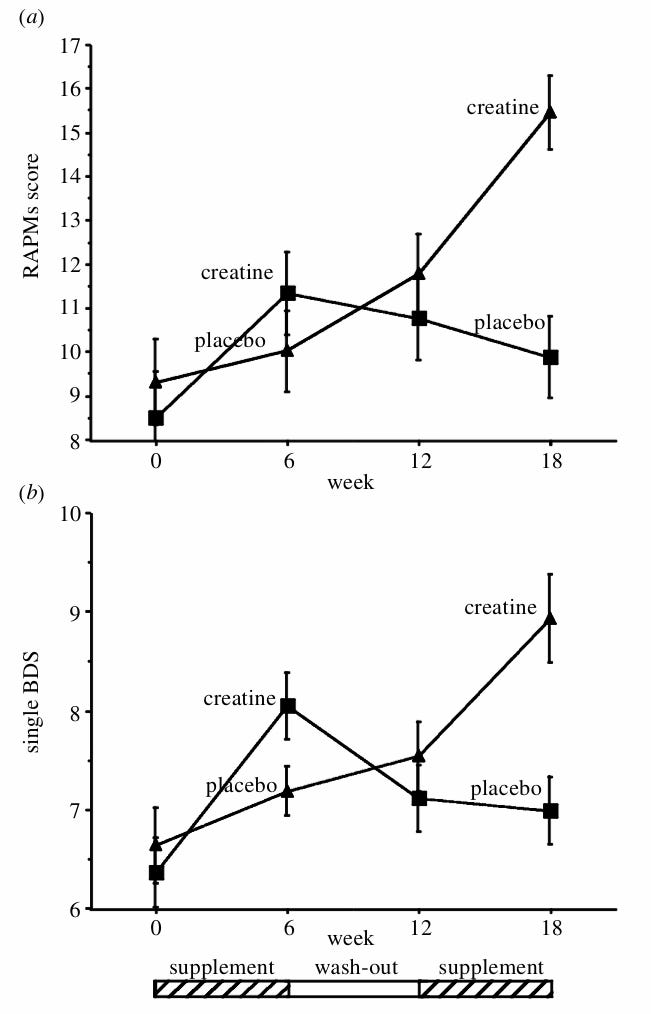
In their analysis, creatine increased BDS by 1.19 standard deviations, and RAPM by 1.76 standard deviations. If we convert those numbers to IQ points (where 1 standard deviation ↔ 15 IQ points), that would mean increases of 17.85 and 26.4 IQ points, respectively. In both cases, the results were highly significant (p < 0.0001).
Does that replicate?
No. Following that paper various groups tried similar experiments but no one found such a large or statistically significant effect. After twenty years of inconclusive results, Sandkühler et al. (2023) set out to give a definitive reproduction. In my view, this is the highest-quality RCT ever done on the cognitive benefits of creatine.15 They largely borrowed the experimental design of Rae et al., although they did the experiment in Germany, used a larger sample of 123 people, used half non-vegetarians, and they dropped the wash-out period. Here are their main results:
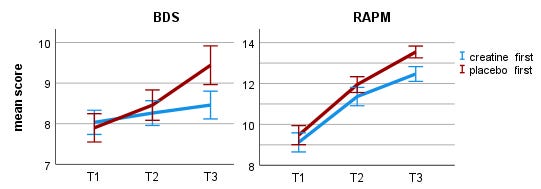
(T1 shows test results at baseline. T2 shows results after six weeks of creatine or placebo. T3 shows the results after another six weeks, where the placebo group crossed over to creatine and vise versa.)
Overall, everyone got better over time, probably from practice. On backwards digit span, during the first six weeks, the group getting placebo actually improved slightly faster than the group getting creatine. But when those groups switched between getting placebo and creatine, that (formerly placebo, now creatine) group improved even faster. Just staring at the graph, this suggests some benefit. On Raven’s matrices, the same thing happened, but with a greatly reduced magnitude.
They fit a statistical model and report an effect size of 0.17 standard deviations for backwards digit span (~2.5 IQ points, not quite statistically significant) and 0.09 standard deviations for Raven’s matrices (~1 IQ point, not even close to significant). They found no extra benefit for vegetarians, not even a non-significant benefit.
As far as I can tell, this discrepancy has never been convincingly explained. Rae et al.’s 2003 experiment seems well done. The results are too large to be explained by p-hacking and too statistically significant to be explained by random noise. Maybe for some reason, Rae et al.’s cohort had lower baseline creatine levels? It’s very odd. But history suggests that when an exciting result is followed by a disappointing replication, we should bet on the disappointing replication.
What about all the other RCTs? Doesn’t this call for a meta-analysis?
In principle, yes. The trouble is, most of the studies don’t report the numbers needed for a good meta-analysis. They do some experiment giving creatine to half of people and placebo to the other half, and measure how those groups do on some cognitive test. Then they fit some statistical model and report p-values or whatever. But they never actually publish the raw means and standard deviations.16
Fortunately for us, Xu et al. (2024) contacted the authors for all those trials and got their raw data. According to their meta-analysis, creatine had the following effects:
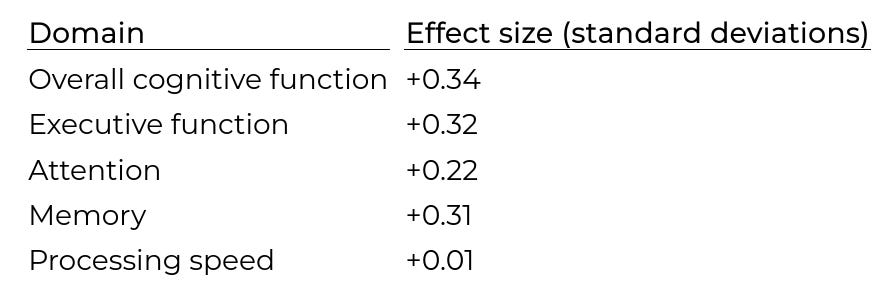
Unfortunately for us, that paper is bad. They claim that several of these results are statistically significant, but a 2026 commentary points out that they made an error that amounts to double-counting the same data for several studies.17 For that reason, I haven’t shown their (incorrect) confidence intervals. If computed correctly, I suspect none of the results would be statistically significant. Technically, the above point estimates are also wrong, although the error shouldn’t systematically bias them in either direction.
In general, I have to tell you that I really don’t trust this paper. It’s very sloppy with tons of missing details. But as far as I can tell, no one else has ever assembled the data needed to do a good meta-analysis. So I think those numbers are the best summary we have.
So who can we trust?
I’ll tell you who I trust: The European Food and Safety Authority (EFSA). In 2024, a firm selling creatine applied to the EU to be allowed to advertise cognitive benefits. This led the EFSA to publish Creatine and improvement in cognitive function: Evaluation of a health claim pursuant to article 13(5) of regulation (EC) No 1924/2006.
Here’s what they have to say (I’ve cut references for readability):
The Panel considers that, overall, the 10 human intervention studies […] do not show a consistent effect of creatine supplementation on cognitive function. The Panel notes that the acute effect of creatine on working memory reported in some studies […] was not observed at lower creatine doses […] or with continuous consumption of creatine. The Panel also notes that the effect of creatine […] reported in one study is an isolated finding across the body of evidence, where no effect of creatine supplementation was observed on other cognitive domains, including different facets of memory (episodic, short‐term, visual), verbal fluency, attention, alertness, processing speed, psychomotor speed, executive function and general cognitive ability/flexibility and fluid intelligence. Finally, the Panel notes that the three intervention studies conducted in diseased individuals do not support an effect of creatine supplementation on cognition.
I think we should consider this definitive. I’d go so far as to say this document probably represents the greatest effort our civilization has ever made to understand if creatine has cognitive benefits.
But we need to remember the ESFA’s role. They’re asking if creatine has been proven to have cognitive benefits, because they’re deciding if it should be legal to advertise cognitive benefits. They say no and I believe them. But that doesn’t mean there are no cognitive benefits.
Are there other reviews of the RCTs?
Yes. Here are all the recent reviews I could find, with a few representative quotes from each:
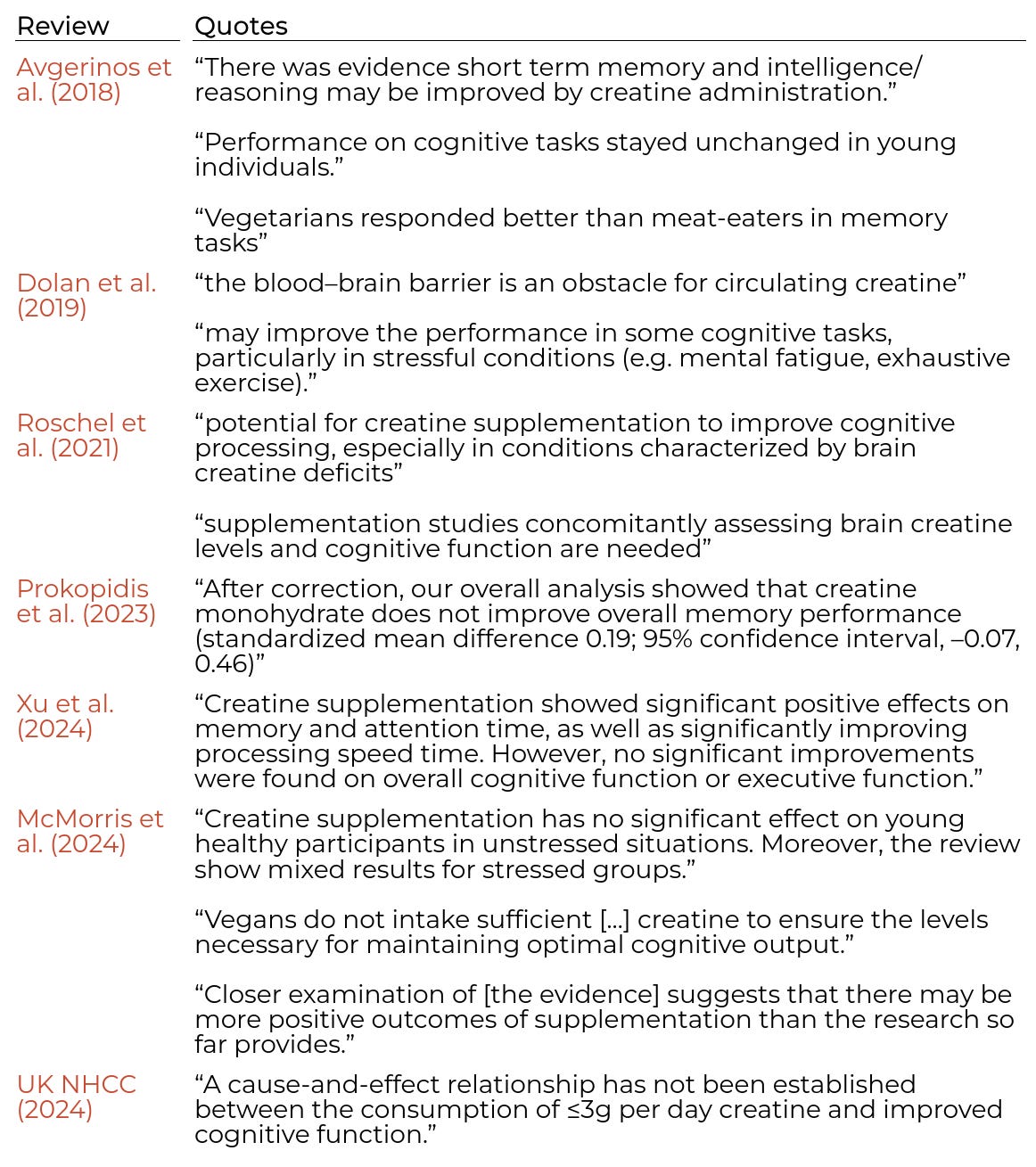
On average, the RCTs do find a small positive effect, just not a statistically significant positive effect. As I so often point out, that’s exactly what we would expect if the true effect were positive but small. But it’s also entirely possible that this is due to random chance or p-hacking or publication bias. Gwern contacted one author and found that publication bias did in fact occur.
Overall, I think the RCTs provide very weak evidence in favor of a small benefit for healthy adults. (Perhaps 0.1 to 0.3 standard deviations, depending on the measure.) I also think they provide moderate evidence against a larger effect for healthy adults (above, say, 0.5 standard deviations) and weak evidence for a small benefit for adults that are “stressed” in some way that might diminish creatine, such as being older, vegan, or physically exhausted.
Can you summarize the evidence in favor of creatine making you smarter?
I would love to do that:
Creatine is special. Very few nutrients really make you stronger, but creatine does.
Few parts of the body other than muscles use significant creatine, but the brain does.
Creatine can cross the blood-brain barrier.
Creatine is vital for the brain to function correctly.
Supplementing creatine probably increases creatine levels in the brain, at least a little.
Some RCTs suggest a cognitive benefit.
Can you summarize the evidence against creatine making you smarter?
Yes:
We don’t fully understand how the brain uses creatine. There is no clear mechanistic story for why supplementing creatine should make you smarter.
The best analogy for how the brain uses creatine is how your muscles use creatine for endurance exercise. But creatine has little benefit for endurance exercise.
It hasn’t been firmly established how much (or if) supplementing creatine increases creatine levels in the brain.
The RCTs suggest a benefit that is quite small, on the order of 1 to 3 IQ points.
The RCTs are not statistically significant.
Does creatine make you smarter?
I don’t know. Maybe a little.
You could make an argument like this: Creatine is crucial for the brain (somehow) so it’s safest to keep levels high, just in case. But I’m not sure I buy that. Creatine is crucial for the brain but there are several hints that evolution knows that, and so regulates levels in the brain more tightly than in muscles.
I might buy that argument for vegetarians or vegans. But there is scant experimental evidence for extra cognitive benefits in those groups, and even some evidence that vegetarians may not have much lower brain creatine levels, despite vastly lower consumption.
And if creatine is helpful, the likely benefit is probably quite small. Say you think there’s a 50% chance creatine increases IQ by 1 point and a 50% chance it’s useless. Is it actually worth the trouble of taking 5 grams of creatine every day for an expected increase of 0.5 IQ points? I’m not sure.
Technically, they found an increase in dihydrotestosterone (DHT) but not testosterone.
Conveniently, in typical cellular conditions, the body can extract around 100 J of energy from 1 gram of ATP. So we can convert 1 gram ≈ 100 J and 1 gram per second ≈ 100 J / second. You may recall from high school that a watt is defined as 1 watt = Joule per second.
Wikipedia quotes a paper saying people make / recycle around 50 kilograms per day. That would imply that people make around 0.5787 grams per second. But this is in tension with the idea that people use 100 watts at rest. Since that 100 watt number seems to be more strongly established, I think 1 gram per second is a better estimate.
Why do you breathe? You breathe because your mitochondria need oxygen to make ATP. When you exercise, you breathe faster so that your mitochondria can make more ATP. You can actually calculate how much ATP your mitochondria make using your VO₂ max score: For each liter of oxygen you use, you make ~21,000 joules of energy, corresponding to ~210 grams of ATP. If you have a typical VO₂ max score of 40 mL/kg/min and you weigh 70 kg, that means you are using 2.8 liters of oxygen per minute, which corresponds to ~588 grams of ATP per minute or ~9.8 grams per second.
A Tour de France cyclist might burn 1500 or even 2000 watts for hours, meaning they are producing ~20 grams of ATP. They can do this because they’ve trained their bodies to have more mitochondria and better oxygen delivery to those mitochondria. But it takes a few seconds for the body to ramp up and start producing this much power.
The “T” in “ATP” is for “triple”, meaning there are three phosphate groups. The “D” is for “di”, meaning there are two phosphate groups.
There’s also stored energy in the form of glycogen. This takes a few seconds to come online, and lasts a few minutes. In a sprint, you aren’t limited by glycogen stores running out, but by having too much acid buildup.
So, effectively, the body has five levels of cached energy:
The mechanical energy stored in the elastic strain of the myosin.
The chemical energy stored in ATP molecules. (Recharges myosin)
The chemical energy stored in (phosph)ocreatine molecules. (Recharges ATP)
The chemical energy stored in glycogen. (Recharges ATP and thus creatine.)
The chemical energy stored in food and fat. (Used to recharge glycogen (food) and ATP (food or fat) and thus creatine.)
It’s 12.5% rather than 16.67% because your short-term energy storage is ~75% phosphocreatine and ~25% ATP, and supplementing creatine does not increase ATP.
I’m not sure to what degree this math actually explains why we see a 5-15% increase in strength in creatine studies versus just being a coincidence. It’s a jump from “X% more short-term energy storage” to “X% increase in max bench press”.
Compared to our evolutionary ancestors, we have long helpless childhoods, low muscle mass, and smaller brains.
I do wonder about this given how many people died violent deaths in non-state societies. But how often would 10% more strength tip the outcome?
I find it amusing that lots of sources refer to extra water retention as a “common side effect” and even report statistics, when a far as I can tell it’s essentially guaranteed by physics.
Tsuji et al. report a phosphocreatine to ATP ratio of 0.77 in grey matter and 2.18 in white matter, Lu et al. reports ~1.45 in entire brains, and Hetherington et al. report 1.0 in white matter, 1.6 in gray matter, and 2.1 in the cerebellum.
Difficulty synthesizing creatine is treated by supplementing creatine. Creatine transporter defect currently has no effective treatment.
After writing this sentence, I later noticed that this experiment had apparently been funded by the Effective Altruism Foundation, Effective Ventures, and personally by (well-known AI alignment researcher) Paul Christiano.
I know this sounds odd, but it’s very common. Everyone wants to establish truth, not just create data so someone else can establish truth. It’s hard to blame them, given their incentives.
Another 2022 meta-analysis by Prokopidis et al. found similar results but apparently has a similar problem. Prokopidis et al. deserve credit for acknowledging the issue and issuing a correction. However, Prokopidis et al. only look at memory, and they seem to be working with before-after scores on the same people, rather than comparisons between the placebo and creatine groups.
I've been running some self-experiments that use my own reaction time as a proxy for cognitive function, following a protocol developed by the late psychologist Seth Roberts. As a long-time vegan, I take in very little dietary creatine, so I expected creatine monohydrate to give me a noticeable boost in processing speed. It didn't. Supplementing had no measurable effect on my speed.
The graph below captures the result. Lower values are better, since they represent faster reaction times:
https://www.self-experiments.org/wp-content/uploads/2026/07/metformin-creatine-graph-1.png
The same graph shows an earlier finding that surprised me: metformin made me faster. I don't have a full write-up of the creatine experiment yet, but I wanted to share the data here.
> As far as I can tell, the list of normal nutrients that have been proven to increase strength is: protein, creatine, beta-alanine, the end.
A note on supplementation in general:
It's often assumed that supplements that provide short term increases in strength will eventually lead to longer terms increases in strength—because short term increases in workout and training volume should in theory translate to more volume stacked over time, which in theory translates to more adaptation. But this is a mere assumption, and I think it’s generally not well-founded: it’s not that hard to push into injury, burnout, or general exhaustion if you just do too much training volume, and you don’t need a supplement to do so. For example, it's well documented that caffeine can increase performance in long distance running, but runners don't supplement caffeine before all of their runs because they aren't limited by the amount of running they do, but how well they can recover and adapt to the running they actually do.
To me, it seems like the supplements that provide long-term benefits are those that assist in *recovery*, which is where all the gains are made anyway. For example, more protein means more muscle protein synthesis. Many anabolic steroids also work on the same principle, granting greater adaptations for the same amount of training stimulus (instead of allowing the user to dump more stimulus onto their body). And of course, the most anabolic natural supplement of all is sleep.
These points in no way refute anything you've said in this article, I just think it's important to note.